The second launch of Beholder: Conductor, 15 months after its release: 81 thousand copies sold in two weeks
Alawar managed to reignite interest in Beholder: Conductor just over a year after its release. The developers did not update the game or its Steam page. How exactly they achieved this is explained by Artem Bashutin, who was in charge of the game's marketing.

Artem Bashutin
It may seem predictable that after a game's release, sales initially spike and then slowly taper off, with the game being purchased mostly during sales. DLCs or significant updates might draw attention again. But what if the team no longer plans to work on the project? Just watch as sales slowly decline?
Beholder: Conductor was different. Fifteen months after its release, the game sparked renewed interest: in just 14 days, we sold 81,000 copies and generated $274,000 in revenue. It was like a full-fledged launch all over again.
We didn't alter the game or its Steam page. No new trailers, capsule updates, or even minor patches. How did we do it?
How the Campaign Developed
It all started with a Daily Deal—a curated feature on Steam's main page. We aim to get this for every game in our catalog that meets the criteria. However, Valve recently announced plans to eliminate the system of curated features.
Valve decides who gets featured on the main page. The discount percentage, however, is determined by the studio or publisher. By the time the Beholder: Conductor campaign began, it was already the top performer among our releases from the previous year in terms of revenue and wishlist additions. So, when we got the Daily Deal, we had a solid foundation for further promotion.
We offered a record discount for the game—70%: the price in the U.S. dropped from $13.99 to $4.19. Why that amount? Simple. We noticed that conversions were worse with discounts under 50%, and Steam itself recommends offering the maximum possible discount for Daily Deals. That's what we aimed for.
From July 20 to July 27, the Steam Train Fest took place. We timed the Daily Deal with the festival as Beholder: Conductor fit the theme and appeared on the event's main page.
We went further and conducted another experiment.
This year, we started working with Jestr to promote games preparing for release. Seeing the results, we decided to test this service's promotional capabilities for Beholder: Conductor, which had been out for over a year. This campaign ran from July 20 to 26 and garnered 9.2 million views on Shorts/Reels/TikTok.
This formed the final combo: a Daily Deal with a significant discount, a fitting thematic festival, and additional attention from outside Steam through content creators.
For comparison: one week before the campaign began, Beholder: Conductor sold 202 copies on Steam, generating $1,071 in net revenue. During the first eight days of promotion, we sold 67,000 copies, and during the entire 14-day period, 81,000 copies. Over these two weeks, Steam recorded 41.7 million impressions and 743,000 visits to the game's page. At peak, it received around 190,000 visits per day.
In 14 days, the campaign generated $274,000 in gross revenue. After refunds and Steam fees, the net revenue was $165,000. Expenses on Jestr had yet to be deducted from this amount; we spent $5,600 on the campaign, which was our only paid promotion outside Steam. Players returned 2,800 copies, approximately 3.4% of those sold. This is a normal refund rate. At the time of preparing this material, Beholder: Conductor's total gross revenue had reached $1.5 million.
The traffic sources statistics painted an interesting picture. Before the campaign, Steam's search suggestions—Search Suggestions—yielded almost no traffic. During the promotion, this source provided over 90,000 visits, with about 36,000 on a single day. Together with direct external traffic, it amounted to roughly 120,000 visits. This is an approximate estimate. A player's path from watching a video to making a purchase doesn't necessarily follow direct links. A player might view a video from a content creator and later open Steam to search for Beholder: Conductor.
We did not issue press releases during the campaign.
We had featured in Daily Deals before, but never with this kind of effect. We believe it's not due to a single feature but how multiple promotional channels amplified each other.
Could the Sale Have Simply Converted Old Wishlists?
Of course, among the buyers were those who had the game in their wishlists for a long time. But here's what’s important: how many purchases came from old wishlists versus new ones? Our hypothesis is that the result was influenced by a combination of several promotional channels, not merely converting old wishlists through the Daily Deal. Cohort data allows us to test this theory.
Within the first eight days, players added Beholder: Conductor to wishlists 83,000 times, with a net increase of 61,000. By the end of the campaign, the total number of wishlists reached 300,000. No comparable spike in additions followed the release.
The table below shows wishlist conversion by cohorts: how many purchases from wishlists occurred each month and what percentage belonged to players who added the game in different years.
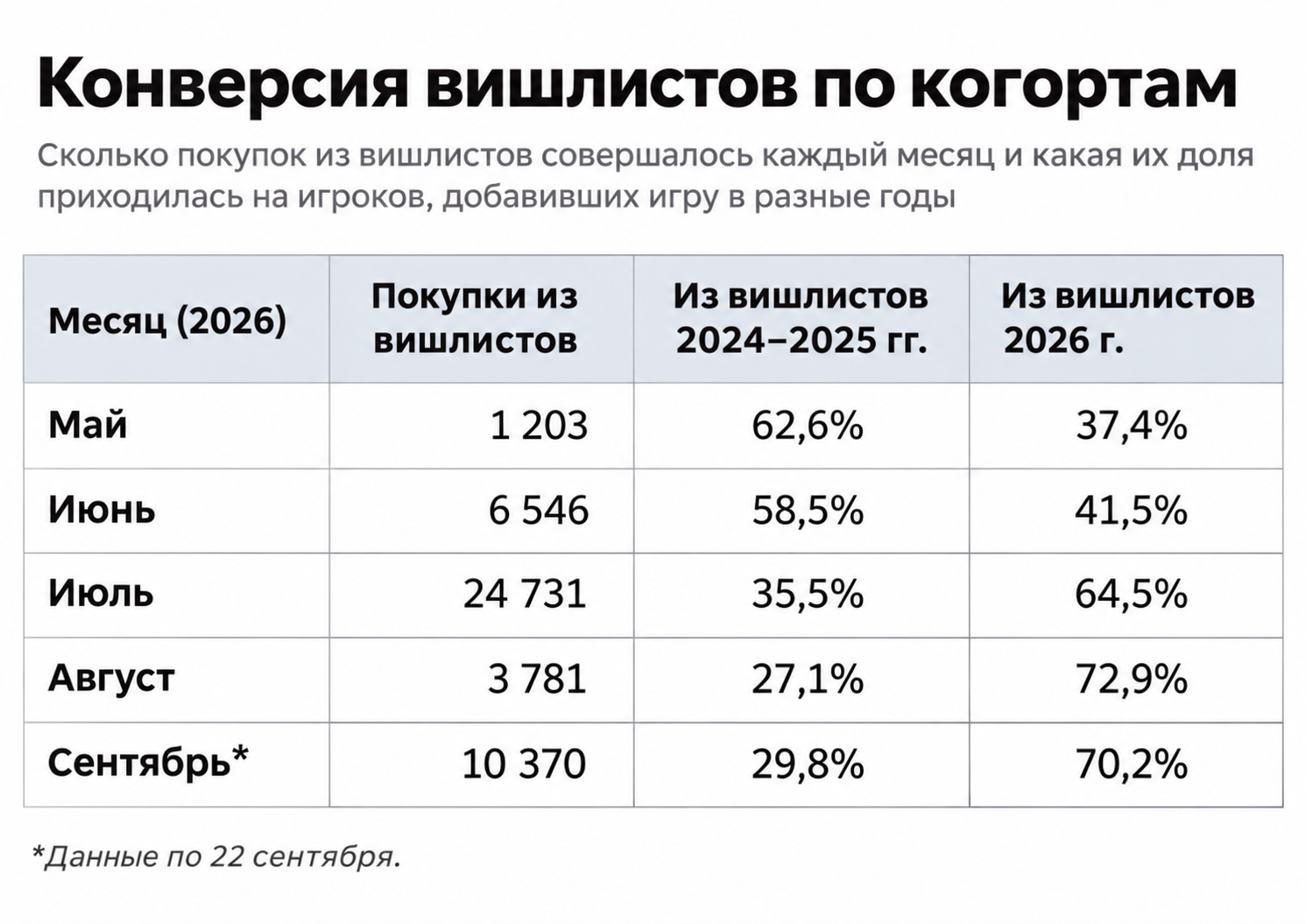
Until July, purchases from wishlists primarily came from those who added the game in 2024–2025, with the share of new 2026 additions slowly rising. In July, the pattern changed: 64.5% of purchases came from 2026 additions.
Purchases from 2026 additions continued in subsequent months: in August, they accounted for 72.9%, and in September, it remained above 70%. The September sale might have prompted purchases from those who added the game to their wishlist around July or postponed it earlier.
Increased Sales for Other Games in the Series
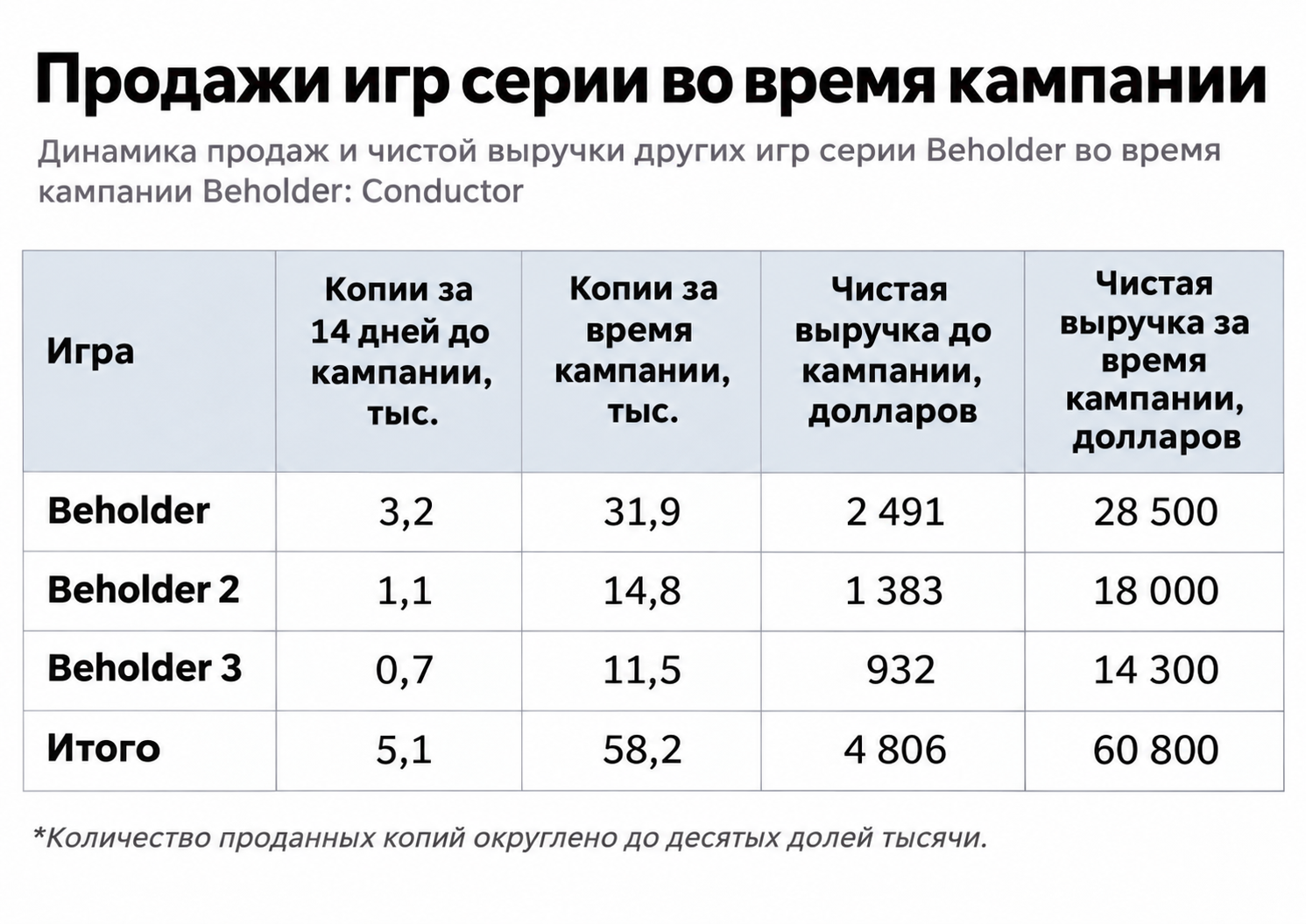
The spike didn’t end with Beholder: Conductor. During the campaign, three other games in the series sold a total of 58,200 copies compared to 5,100 in the two weeks prior. Their combined net revenue grew from $4,000 to $60,000.
Similarly, bundles were bought more frequently. Three bundles containing Beholder: Conductor or the entire series were purchased 37,700 times during the campaign. In contrast, they were bought only 1,800 times in the previous two weeks.
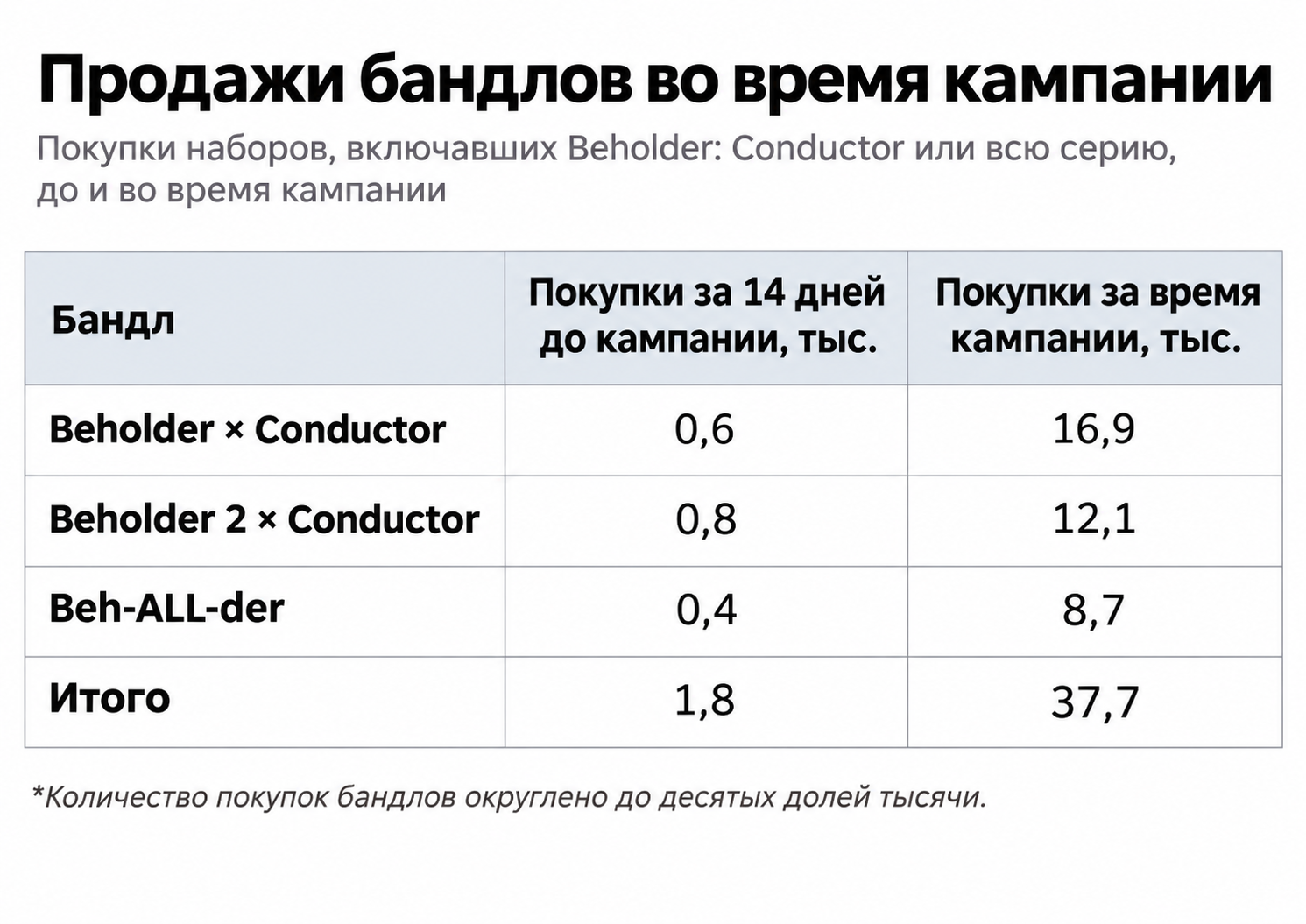
It seems that Beholder: Conductor also drew attention to the rest of the series. Some buyers came for one discounted game and ended up purchasing additional parts as well.
Lessons Learned
If an already released game secures prominent placement on Steam, such as featuring in a fitting festival on the main page, it's worth considering what other promotional channels can be leveraged during those dates. In the case of Beholder: Conductor, a combination of a Daily Deal, Steam Train Fest, and promotion through content creators with Jestr significantly enhanced the campaign's effectiveness. Each game will have its own lucky combination. We plan to test this approach on other projects in our catalog.
It's especially satisfying to achieve such results in an anniversary year: in November, the Beholder series will celebrate its tenth anniversary. A decade after the first game's release, it continues to find new players.
We wish your games grow into their own franchises that attract new audiences for decades. And if you decide to run a similar campaign for one of your projects, let us know how it went. We’d be interested to hear about your results.