From Supercell to Indie Developers: How Finland's Gaming Industry Is Structured and How It's Evolving Today
Like many mature markets, Finland is experiencing a transitional period. On one hand, the industry is still quite polarized. On the other, it has become noticeably more diverse over the past few years. However, it's far from certain that the creators of notable indie hits in recent years will be able to build sustainable businesses.
Finnish Game Development in Numbers
The economic foundation of Finnish game development remains the major mobile business, around which the main capital and revenue are concentrated. However, Joni Lappalainen, Chairman of the Finnish Game Developers' Association, notes that in 2025 the local gaming industry experienced a “true renaissance in the segment of multiplatform and PC games, especially thanks to a significant increase in the visibility of games sold on Steam.”
This is well illustrated by examples we will discuss further. The focus is primarily on releases from independent teams and emerging developers. This raises the question: is the diversity that has emerged enough to form a new wave of sustainable game businesses beyond mobile and the rare studios with a rich history like Remedy?
First, let's go over some numbers. The last more or less complete report on the Finnish gaming industry from the local organization Neogames covers only the years 2023–2024. Below are the main figures for 2024:
- the total turnover of Finnish gaming companies was 2.85 billion euros (5% less compared to 2022);
- estimated operating profit was 400 million euros (half of what it was in 2023);
- the number of employees in Finnish game development was 4,300;
- the number of active studios was 270 (28 more than in 2022);
- the number of studios with a turnover of 1 million euros or more was 37 (compared to 45 in 2022);
- the number of studios with a turnover of 100 million euros or more was 4 (unchanged).
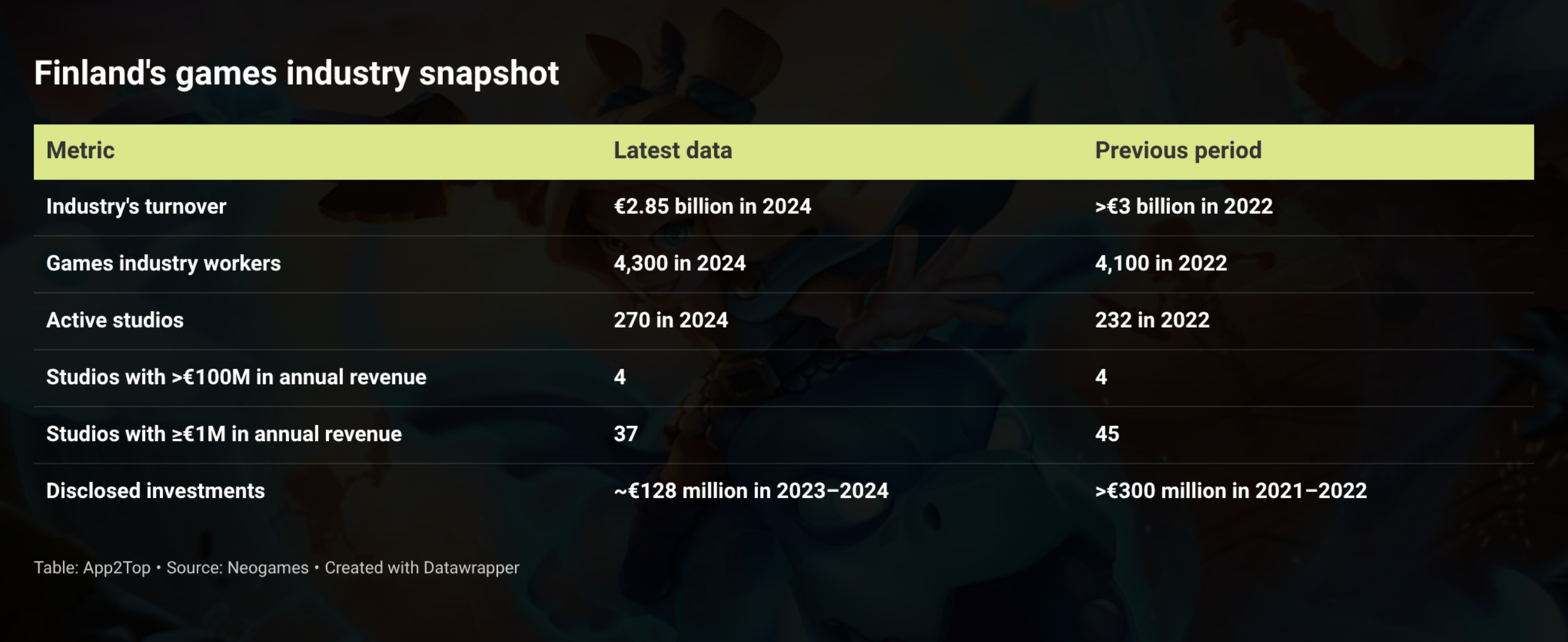
Overview of the Finnish Gaming Industry | Data: Neogames