"Major teams are increasingly moving towards building reusable systems," said Pavel Ignatov and Mikhail Khripin from Balancy regarding the outcomes of 2025
With Christmas approaching and the New Year around the corner, we continue summing up 2025 with gaming (or game-related) teams. Next up is an interview with Balancy. We spoke with Pavel Ignatov, the company's CEO, and Mikhail Khripin, the product owner of the service.
How was the year 2025 for your LiveOps business? What achievements would you like to highlight?
Pavel Ignatov, Balancy: The year 2025 was significant for the platform: individual modules formed a full-fledged LiveOps stack, meeting the key needs of studios.
One of the main directions was developing a visual interface constructor. Now game designers and monetization managers can assemble offers, mini-games, and events as easily as they create layouts in design tools. The preparation time has been reduced from weeks to minutes—without involving engineers or releasing a new build.
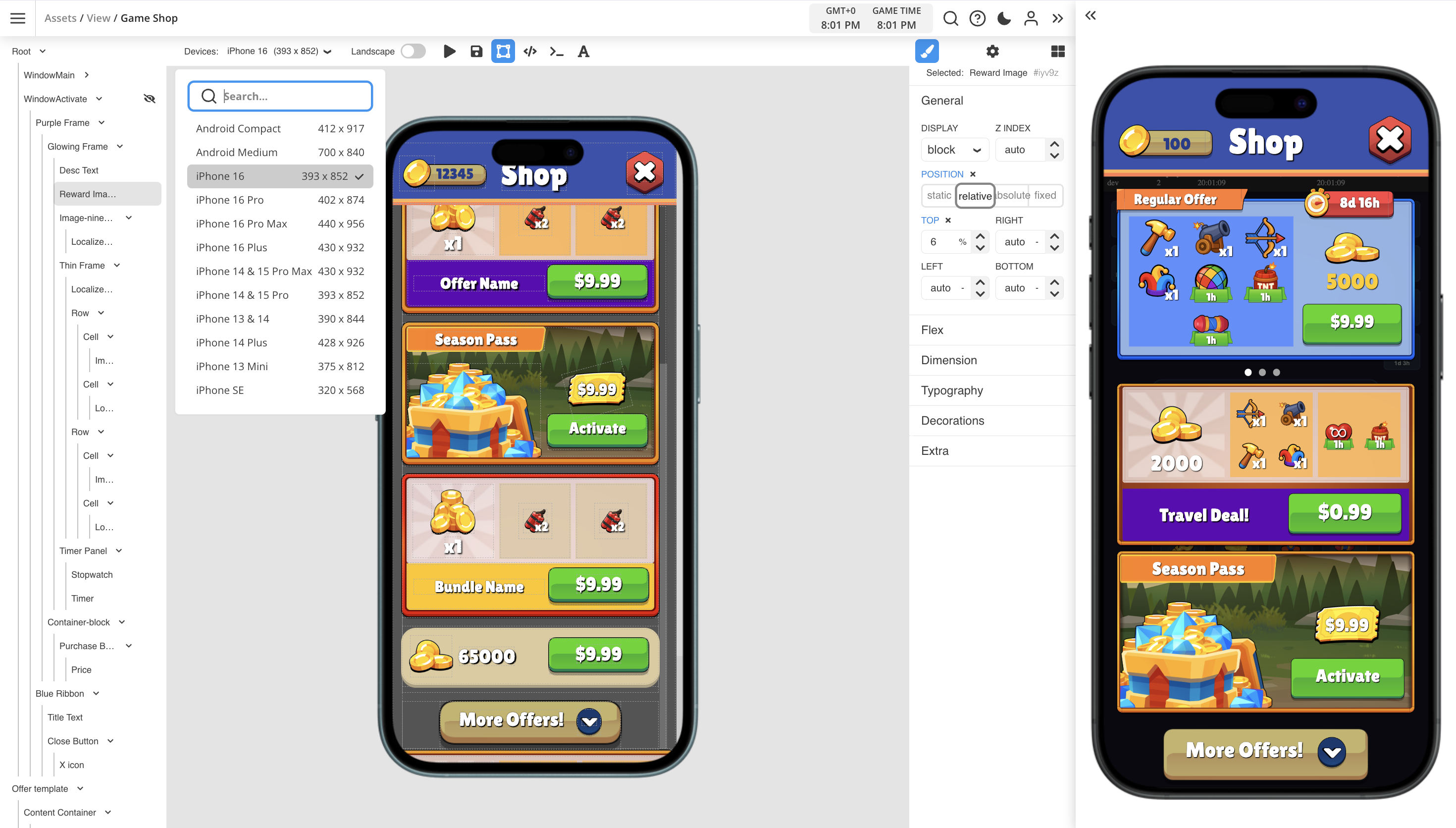
Example of a store assembled in Balancy's UI constructor: ready-made structure, visual adaptation, and the ability to test monetization without programmer involvement
At the same time, we began working on an event template library. We studied approaches from top projects and turned them into a set of ready-made solutions. Templates akin to Royal Match are already available. Previously, creating such chains, configuring connections, and adapting rewards required significant resources. Now all this can be assembled in minutes and tailored to the game's art and economy.
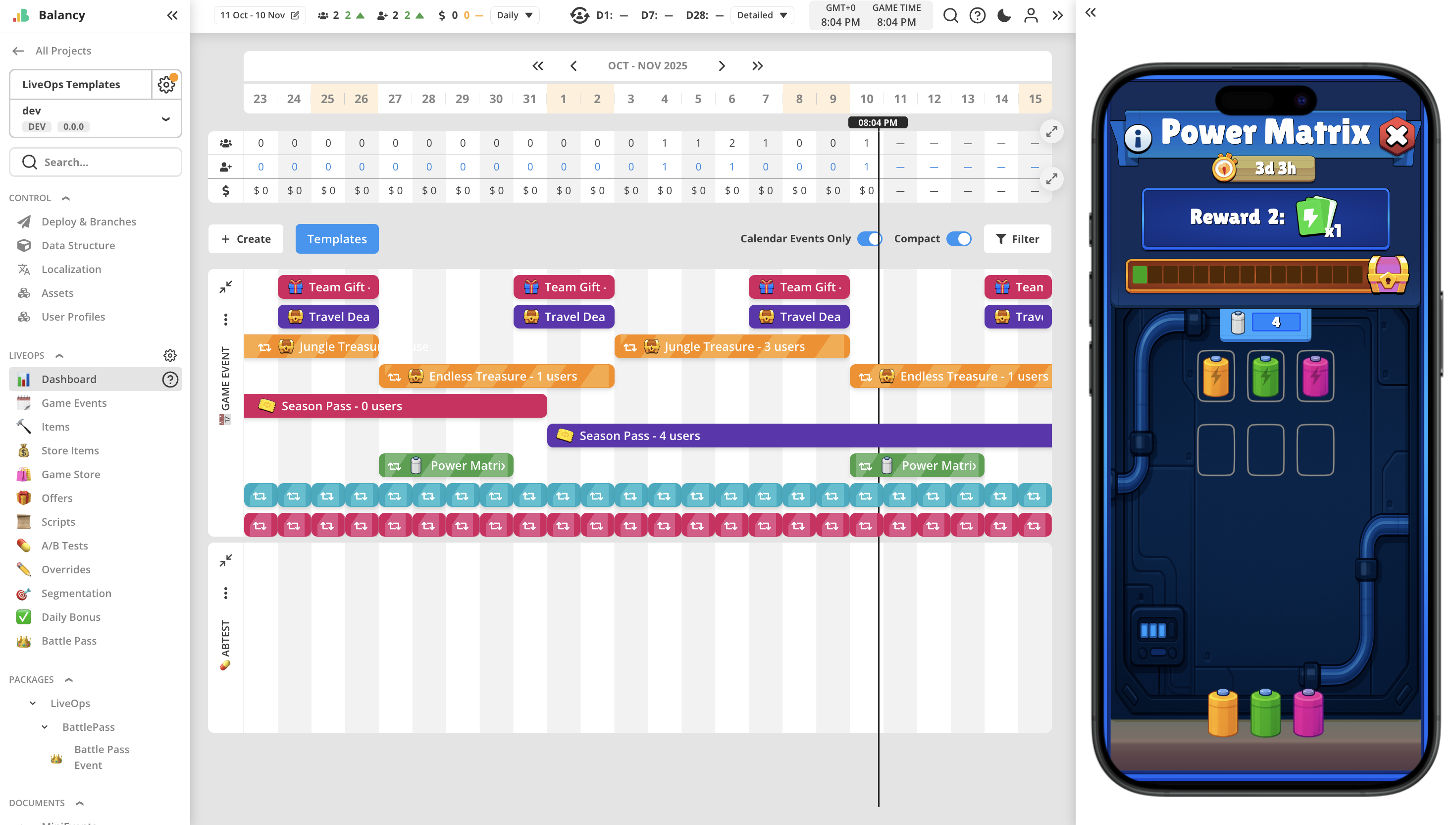
Power Matrix mini-game template in Balancy — an example of ready-made solutions studios can use when building a calendar
This approach speeds up idea testing and helps to build a rich event cycle. When a player opens a mini-game with resources they've just acquired after a quest, it creates a coherent experience that audiences greatly appreciate.
Mikhail Khripin, Balancy: We also introduced a new product — the "Publisher Platform." It allows not only working with a single game but with a portfolio of projects: tracking the dynamics of each game, comparing results, establishing a unified approach to LiveOps, and transferring successful practices between teams.
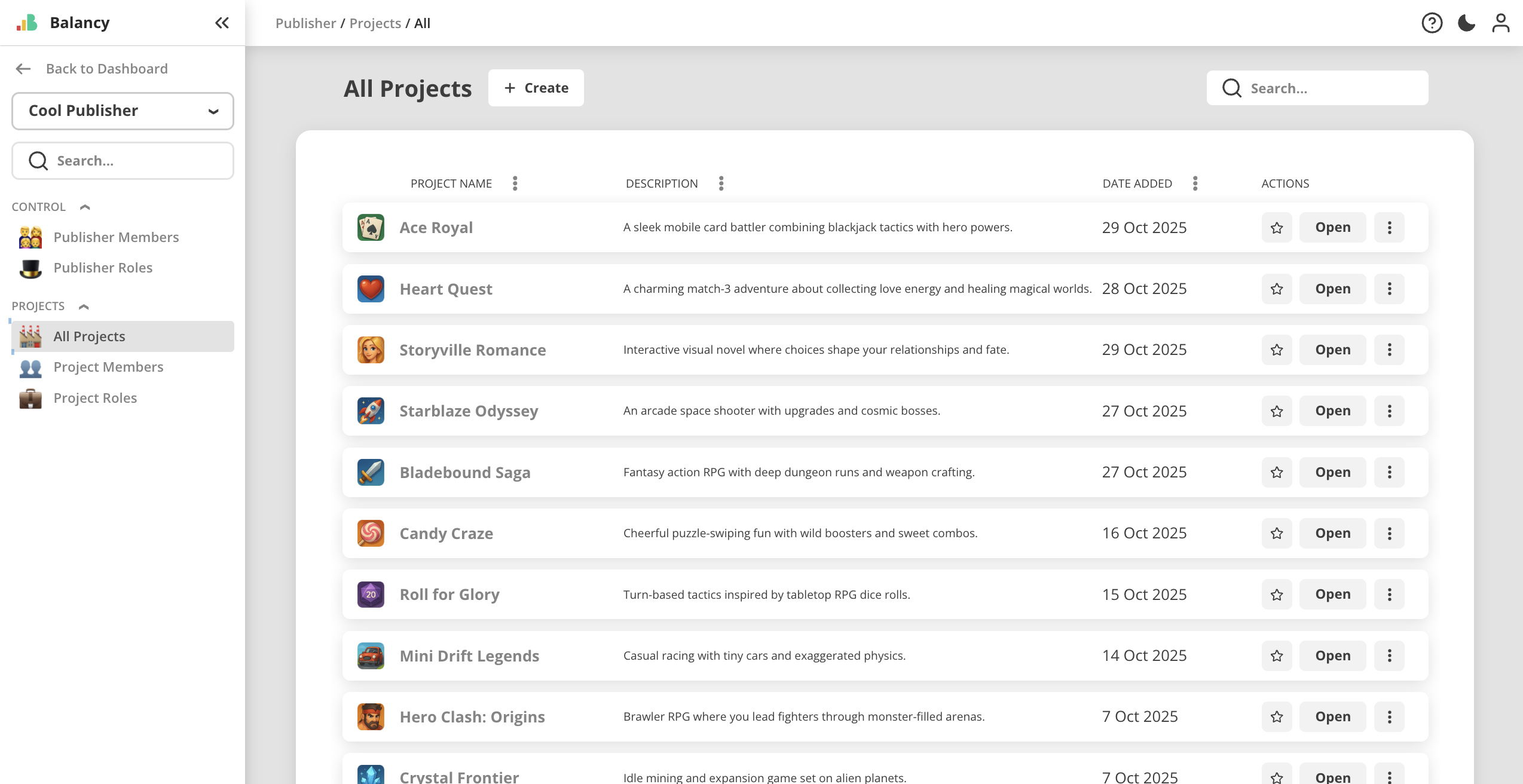
"Publisher Platform" — a single control point for projects, access, and working practices
According to our estimates, the total revenue of games operated on Balancy in 2025 amounted to about $60 million. This shows that the platform addresses real challenges and helps studios grow.
How have approaches to LiveOps — personalization, events, economy — changed over the year?
Pavel: In 2025, teams have noticeably structured their approach to LiveOps. Studios pay closer attention to what happens with the game post-release: instead of one-off initiatives, regular processes with clear goals and measurable effects are being established.
Personalization: moving from groups to player context
Segmentation has already become standard—no one is surprised by it anymore. The main change of the year is the focus on personalization. The game responds not to the user's group affiliation but to their current context: playstyle, recent actions, frequency of logins, and progress status.
This approach makes events and offers more accurate and significantly enhances LiveOps effectiveness.
Templatization: shifting from 'handcrafted' to a conveyor of successful solutions
Mikhail: We must highlight templatization — one of the year's strongest trends. Large teams are increasingly moving from creating individual features to building reusable systems.
A good example is Habby. Despite the different genres in their portfolio, the studio's games rely on a familiar meta-structure: upgrades, limited-time offers, and understandable event loops. This approach allows:
- faster release of new projects;
- reduce risks by using already proven solutions;
- synchronize LiveOps across games;
- transfer working mechanics from one title to another;
- more effectively test and scale the economy.
Templatization makes LiveOps predictable: a successful construct, once found, starts working as a system that can be adapted rather than reinvented.
Events: frequency, flexibility, and cycle management
Studios are increasingly moving away from large, infrequent updates. Players value dynamics—mini-events, short promotions, and seasonal activities.
The key demand is the ability to quickly change the plan: launch experimental mechanics, adjust conditions, extend or shorten events. This helps to manage audience attention more precisely and maintain interest.
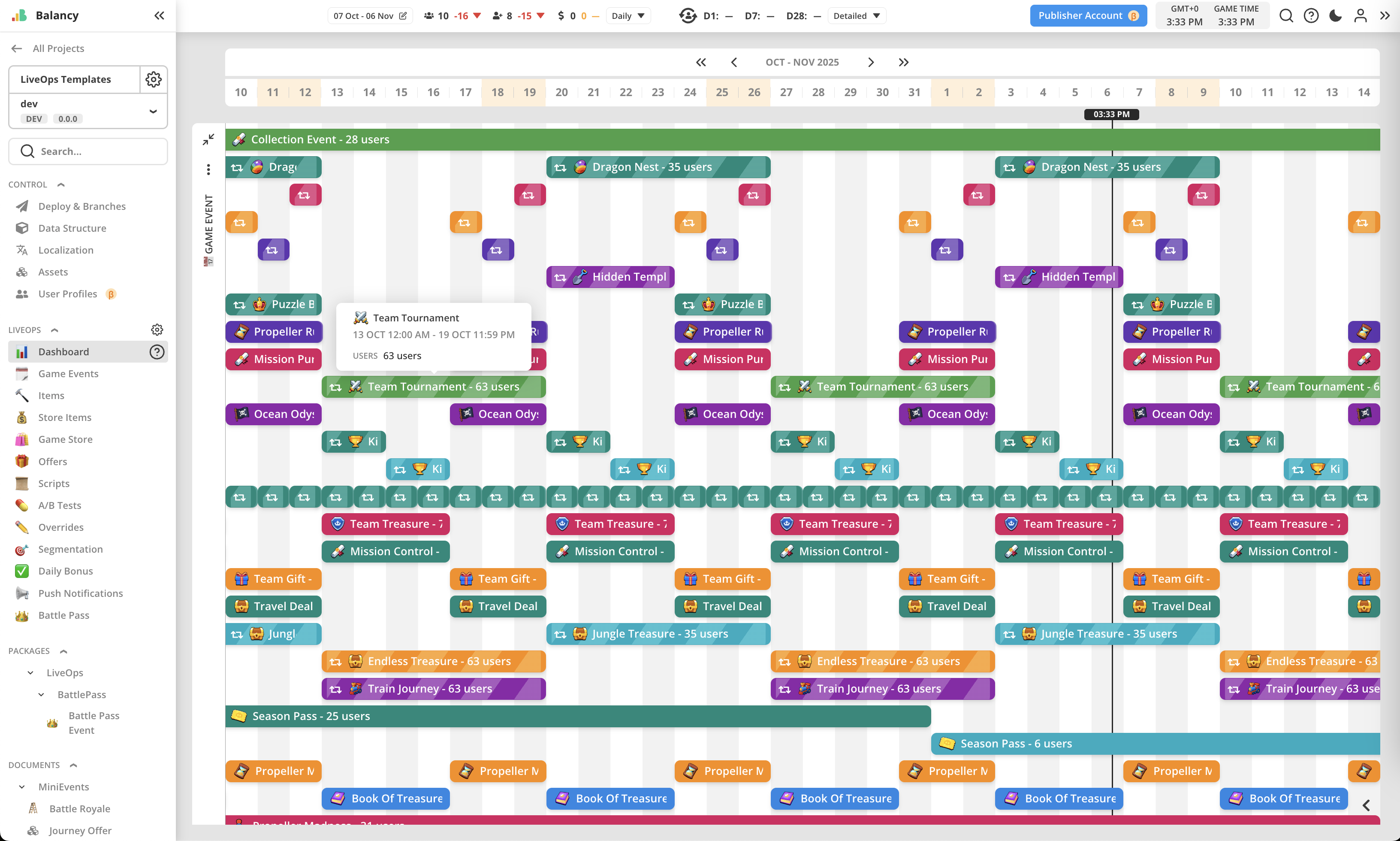
Balancy's event calendar: visual management of events, their duration, and connections within LiveOps cycles
Economy: flexibility and discipline in hypothesis testing
Pavel: Rising acquisition costs make in-game economy a constant focus area. Studios combine different revenue streams—purchases, advertisements, limited-time offers—and pay more attention to hypothesis testing. Discipline is crucial: comparing options, recording results, and making data-driven decisions.
Mikhail: LiveOps is becoming more technological, structured, and predictable. The focus shifts towards a systematic approach:
- understanding the audience more precisely,
- using templates,
- testing ideas,
- quickly releasing events.
This systematic approach gives teams more control and stability.
Has the LiveOps offering market changed?
Pavel: Over the past year, the LiveOps platform market has advanced noticeably. Several key trends can be highlighted.
- Full-fledged stacks are forming. Narrow solutions have given way to cloud platforms that combine tools for segmentation, events, monetization, content, and testing.
- Interest is growing among studios that need to update games quickly and manage multiple projects simultaneously. In such conditions, proprietary tools become too costly and require continuous support.
- The power of tools is increasing. Platforms allow flexible economy management, real-time player behavior analysis, integration with server components, and other systems, lowering the technical barrier.
As a result, the market is becoming mature: solutions are emerging that can support large projects and compete with internal tools.
How have client requests and expectations changed?
Mikhail: In 2025, studio requests became more specific. They expect from LiveOps not separate modules, but a flexible system that helps manage the game daily. Key tasks have come to the fore:
- the ability to change a game quickly without a new build;
- personalization of offers and events to fit the player's lifecycle;
- built-in tools for hypothesis testing and key metric evaluation;
- lowering the technical threshold, so designers and LiveOps managers can launch campaigns independently;
- managing multiple projects simultaneously and transferring successful practices between teams.
LiveOps is increasingly perceived as a permanent tool for game development.
What lessons from 2025 can assist studios today?
Pavel: For games that rely on regular player activity—from casual and hybrid to midcore and other free-to-play projects—LiveOps should be embedded from the start. Experience from 2025 has highlighted several principles crucial for long-term development:
- embed the "game as a service" architecture: server-side, analytics, segmentation, and flexible configuration right from the project's inception;
- invest in analytics: understanding player behavior and regular hypothesis testing are the foundation of personalization;
- maintain a balance between planning and flexibility;
- ensure the independence of the LiveOps team so that the cycle of "idea—launch—measurement" does not rely on the main development;
- foster an open dialogue with players: transparency in decision-making directly influences loyalty and retention.
These principles help to operate sustainably even amid high competition.
What trends do you anticipate in LiveOps tools and automation in 2026?
Mikhail: In 2026, LiveOps will continue to evolve in several directions:
- automation will intensify: behavior analysis, churn prediction, offer selection;
- interest in comprehensive platforms that combine tools, analytics, and event management will increase;
- the significance of predictive models will grow—studios need to anticipate audience reactions to changes;
- the standards of LiveOps content quality will rise—templates and logic sets will help maintain high levels even for small teams;
- successful practices will spread even faster between genres and projects.
Tools are becoming more powerful and accessible, and interest in LiveOps is growing across projects of all sizes.
What goals are set for 2026?
Pavel: In 2026, we continue advancing towards a more comprehensive and user-friendly platform. Key objectives include:
- expanding the template library;
- developing the "Publisher Platform" and enhancing portfolio management tools;
- testing automation tools—segmentation, personalization, dynamic pricing;
- improving integration and performance for projects of various scales;
- building an ecosystem around Balancy—templates, training, methodologies, and support.
These directions will help studios work faster, more confidently, and focus on game quality and player engagement.