Playgama has launched the AI Game Index—a service for evaluating AI models based on the results of games created with their help
Playgama has introduced the AI Game Index—a service that compares AI models and game development tools based on actual player behavior. Unlike traditional AI benchmarks that assess specific task performance, this index considers user engagement in published projects.
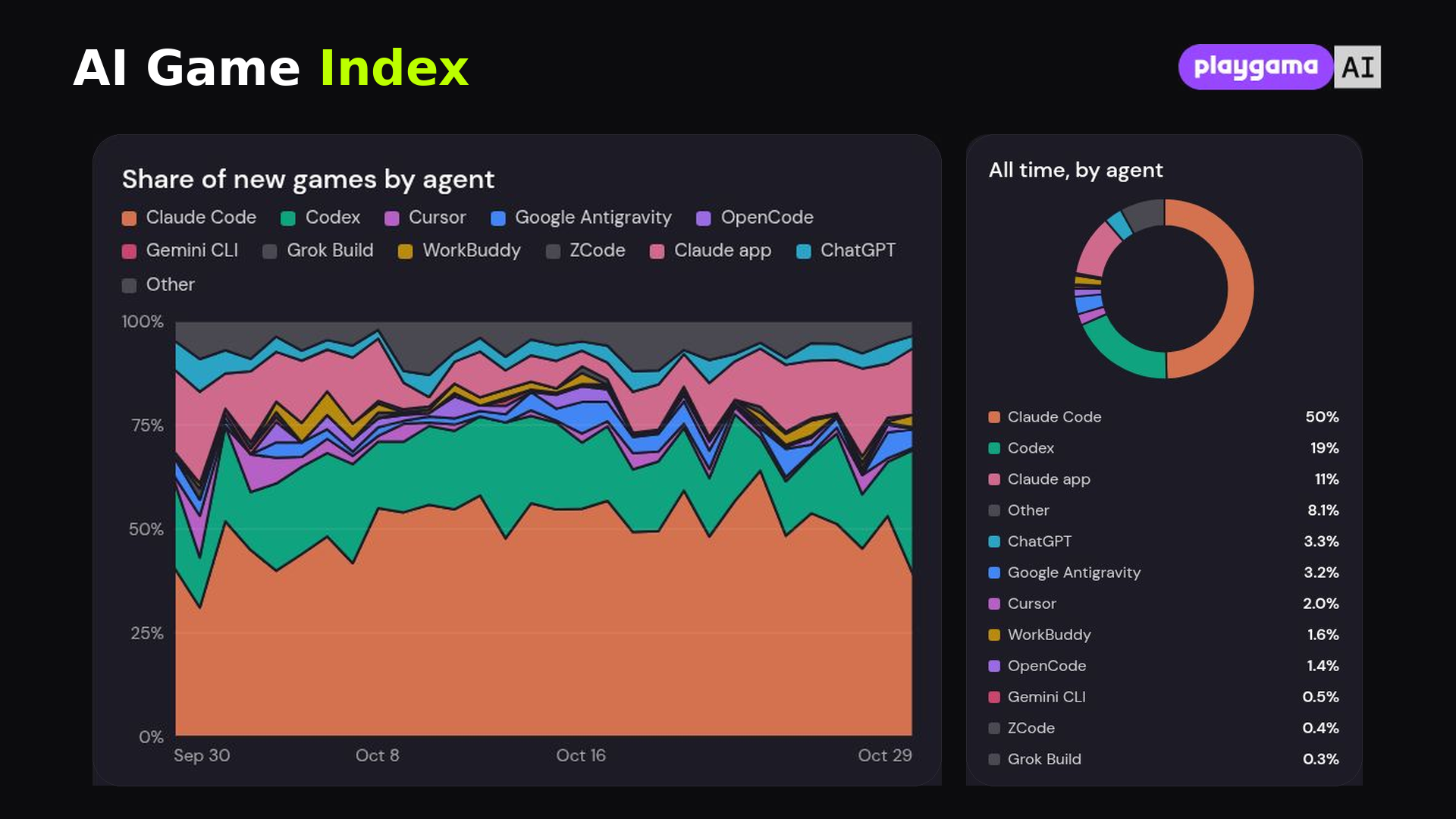
The index is available on Playgama's website and updates daily. As of October 29, 2026, its database covers over 5.4 thousand browser games and 1.4 million launches on the Playgama Sandbox platform.
Here's how the AI Game Index works. When a game is published on Playgama Sandbox, the developer specifies which AI tool and model were used. For instance, the tool could be Claude Code or Codex, and the model might be Claude Opus or OpenAI Astra. The service collects player activity data and creates separate rankings for models and tools based on this data.
According to current data, the most common development tool in Playgama Sandbox is Claude Code, used in creating 50% of the games. It is followed by Codex (19%) and Claude application (11%).
In terms of player likes, games developed with OpenCode receive the most likes (64 likes per thousand launches), followed by Codex (55 likes) and ChatGPT (50 likes).
Among AI models, Claude Opus leads in prevalence with a 56% share. OpenAI Sol accounts for 10% of projects, and Claude Sonnet for 9.1% (data on the site is dynamic and may differ from the figures provided here).
However, engagement results vary. For example, games developed with OpenAI Astra receive 65 likes per thousand launches, compared to 38 for Claude Opus, with DeepSeek leading at 72 likes. Meanwhile, in terms of average session duration, games created with Gemini Pro lead at 4 minutes 30 seconds, compared to 4 minutes 20 seconds for Astra.
Nonetheless, the index's authors caution about the study's limitations. It only considers games from the Playgama Sandbox, and developers self-report the models used. Additionally, factors such as genre, project quality, marketing, and others that are not directly related to AI capabilities can influence engagement.
A small note from the editors: if you're collecting data via AI, be diligent in verification, as some AI may sometimes ignore competitors while fetching information.